Tucked deep in the rugged Elk Mountains of Colorado lies the tiny town of Marble. Once a booming mining town with thousands of residents, it is now just a few locals. Marble is home to one of the most beautiful marble lodes in the world. Prized for its fine grain, luminous quality, and subtle undertones, this exceptionally pure white marble is a wonder of nature.
It was selected as the building material of the Tomb of the Unknown Soldier at Arlington National Cemetery, the Lincoln Memorial, and the Colorado State Capitol building among hundreds of other buildings and monuments. It is also the preferred material used by our lodge for Cornerstones and adornments in our lodge room.
Its unapparelled beauty is reason enough to select it for a project but there are other important reasons. The pure white color reminds us of the lambskin, an emblem representing our pursuit of purity in life and conduct, and the badge of a Mason. Best of all, Yule marble is named after Bother Freemason George Yule, the geologist that discovered the lode.
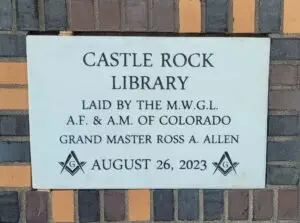
You can see our most recent Cornerstone made from Yule marble outside the East entrance to the Philip and Jerry Miller public library on south Wilcox Street. If you visit our lodge room during an open house you will see a number of items made from Yule marble as well.
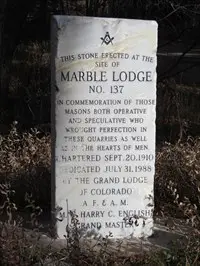
Yule marble cornerstone outside of Castle Rock public libraryMarble Lodge No. 137 stone marker
Interestingly, Marble, Colorado was once home to a Masonic Lodge called Marble Lodge No. 137. Chartered in 1910 this lodge was home to both speculative and operative masons who worked in the famous quarry. Unfortunately, the lodge has been lost to history and now just a stone marker remains. If you’d like to read more about the history of Marble Lodge No. 137 keep reading!
Presented here in full with permission from Memorials Markers Monuments by the Most Worshipful Grand Lodge of Colorado A.F.&A.M Sesquicentennial (150th) Anniversary 2011
A History of Marble Lodge No. 137
In 1910, eleven Brethren petitioned the M.W. Grand Lodge for a dispensation to organize a lodge at Marble, Colorado. R.W. Bro. W.W. Cooper, Grand Lecturer, after twice visiting the area, furnished the following information to the Grand Master:
There is no question in my mind that this town has every indication of being a permanent one, capable of supporting a Masonic Lodge, and is far and beyond the average mining or coal camp. While realizing that no man can see into the future, from personal observation and investigation on the ground, I strongly recommend that a dispensation be granted to form a lodge at Marble, Colorado.
M.W. Brother George W. Musser Granted a dispensation on February 21, 1910. At the Grand Lodge Session that year, the returns showed that the Lodge had held twenty-seven communications, initiated eighteen, passed fourteen, raised eleven, and recommended one in addition to those whose names appeared on the petition for Dispensation who presented a regular demit. Marble Lodge No. 137 received its Charter during the Grand Lodge Session on 20 September, 1910. The lodge was constituted, the officers installed, and the temple dedicated in a Grand Lodge ceremony on Oct. 29, 1910. On September 9, 1918, the Charter was arrested and all books and paraphernalia ordered sent to the Grand Secretary.
The story of what took place during that short eight years of existence for Marble Lodge No. 137 is really the story of the town of Marble and the marble industry in Colorado. Grand Lecturer, R.W. Bro. W.W. Cooper stated in one of his letters to Grand Master Musser, during his investigation of the petition for dispensation: The men from whom this lodge will secure its members consist of the employees of the ColoradoYule Marble Company, including managers, superintendents, clerks, draftsmen, foreman, electricians, machinists, and skilled marble workers, together with the business men who supply the needs of the foregoing. The proposed Master, M.E. Granger, is the chief clerk of the Colorado-Yule Company and is from Vermont. Charles E. Miller, proposed Senior Warden, is a foreman of the same company and is from Kentucky. George F. Hoadley, the proposed Junior Warden, is an electrician and is from Illinois. He stated further that “the community is supported directly or indirectly by one industry”.
One of the peak years in the history of Marble was 1910. Despite the official census of 782 people, population estimates for the area included 2000 people, with between 500 and 700 employed in the various marble operations alone, drawing a monthly payroll of $40,000. When the lodge received its charter in September, 1910, twenty-three names appeared thereon. In April 1911, E.O. Pratt, a charter member of the lodge, was elected mayor. He was admitted from Stonington Lodge No. 503 in Ohio, was lodge Treasurer under dispensation and during 1911 through 1913. He was Worshipful Master in 1915. Several other lodge members held positions of distinction in the community. Cassius E. Budlong served as Justice of the Peace and Magistrate during 1913 and 1914 and again Magistrate through 1917. He was Senior Warden in 1917 and 1918. Charles L. Jeanes, who received his degrees in Marble Lodge in 1910, was the town treasurer in 1911. James F. Manning, another charter member of the lodge, became the President of the Colorado Yule Marble Company in 1916. Eugene D. Pratt was mayor in 1910 and 1911. Frank B. Stephenson, who received his degrees in Marble Lodge in 1910, was a respected physician for many years and Mayor in 1916 and 1917. James A. Walton, who was admitted to Marble Lodge in 1911, was the pastor of the Congregational Church in 1912.
The community prospered as the marble industry prospered during 1911-1914. In 1911, the lodge raised five and admitted 14. This added 19 to the original 11 for a total of 30 members. In 1912, the lodge continued to grow to 37 members. In 1913, 11 were added to the rolls for a total of 48, the peak number during the history of the lodge. Marble is still in its greatest boom as 1914 opened. The Colorado-Yule Marble Company had secured the contract to provide marble for the Lincoln Memorial and many other profitable contracts were either coming in or expected. The people of Marble, with the exception of the foreign element in town, paid little attention to the darkening clouds in Europe in 1914. The foreigners, however, had relatives abroad who were destined to be caught up in the developing great war. During 1914, many of the skilled Austrian artisans were called to return home to fight for their country. This coupled with the Italian exodus after their entry into the War in 1915, deprived the town of a great portion of its skilled labor.
Marble was upset over the loss of its top skilled workers just at the time business was booming, and they were most needed. The Marble Booster reported: There’ll be lots of those Italian boys who will never see Marble again that’s sure. They’re leaving here in squads of ten or fifteen, sometimes twenty-five, every few days now, at the call of their consuls, and there’ll be plenty of them who never will take up a marble tool again. This is just one more argument why the Italians who are intelligent and progressive- Italians whose good sense ought to persuade them- should become naturalized citizens of the United States instead of earning their money here, making a home here, and then be subjected to call to go back to Italy to be shot.
During 1914, the lodge showed its first decline in membership, with a loss of four, resulting in a total membership that year of 44. During 1915, the Crystal River Marble Company, which started in 1904, ceased operations. To all outward appearances, the Colorado-Yule Marble Company and the town of Marble were prospering in 1915. President Manning was highly optimistic about the future. However, despite the appearance of wealth and prosperity, the company was in financial trouble. With the country gearing for war and with the introduction of new construction and building materials, the demand for marble decreased. Sadly, despite heroic efforts by many, Marble began its slow slide downhill. In 1915, the lodge raised four, but demitted three and suspended two for a net decrease of one. The membership stood at 43. The town maintained prosperity during the early months of 1916. The Colorado-Yule Marble Company was ranked as the second largest marble concern in the world. However, the company had badly overextended itself financially, and as the demand for marble declined, it was necessary to place the company in the hands of a receiver on July 18, 1916. President J.F. Manning was named as receiver. By September, less than 200 men were employed by the company. In 1916, the lodge amazingly enough, showed an increase of three, for a total membership of 46.
The Colorado-Yule Marble Company ceased operations completely on April 15, 1917. That year, the lodge showed a decrease in membership of five, including no raisings, one death, and four demits. The Lodge membership was now 41. The proceedings of the 1918 Grand Lodge session included the following: The condition of Marble Lodge No. 137 has been anything but good for a long time. Its members are scattered and less than a quorum reside within the Jurisdiction of the Lodge. Several members have attempted to obtain dimits, but the lodge could not act because of lack of quorum. The Lodge was quite heavily involved, but its Junior Warden, the only officer resident in Marble, informs me he has succeeded in collecting dues to pay off its obligation. After carefully considering the condition of the Lodge, I came to the conclusion that revocation of the Charter was necessary and accordingly took steps to carry out my conviction. The Junior Warden, however, asked that such action be deferred until just before the meeting of the Grand Lodge, as he had hopes that the economic condition of Marble would greatly improve and that the Lodge would resume normal life. Such, however, has not been the case, and I have received no assurance that his hopes will be fulfilled. On the other hand, recent information discloses the fact that only three members reside in Marble. Therefore on September 9, 1918, I arrested the Charter and ordered all record books and paraphernalia sent to the Grand Secretary.
So ends the history of Marble Lodge No. 137. Despite the fact that World War I had indirectly helped to destroy the marble industry in the Crystal River Valley, Marble sis not become a ghost town; it continued to exist through 1919 and 1920, although its population decreased to 81. In 1921, there was a small amount of activity in the marble companies as well as the discovery of some rich silver traces which attracted several prospectors. However, the ore did not pan out and Marble received more publicity than prosperity from the find. In 1922, marble production was resumed; however, the town never regained the population and prosperity it had enjoyed before the great war. At 3:15pm on August 8, 1941, a wall of water, mud and rock cut a 1,000 ft. swath thought Marble, leaving mud rocks, and twisted trees piled up to a depth of 20 feet. Several buildings were washed away or covered with mud and rocks. One house was swept away, coming to rest against the Masonic building.
On Saturday, October 25, 1941, the quarry ceased operations and the electric tram brought the last white stone down the 17 percent grade. On the first of the following month, a small crew of men started to dismantle the equipment at the quarry. On Nov. 15, the largest marble producing mill in the world closed for the last time. A second flood on July 31, 1945, far worse than the 41 flood, completed the destruction of the Masonic building and its remains now laeyburied under several feet of mud and debris.